London’s forgotten cockpit
In the 1530s Henry Vlll took time off from closing the monasteries to build a private cockpit for himself and his royal buddies. It was to become a feature of the new royal palace he was building along today’s Whitehall. Cockfighting, nowadays rightly thought of as barbaric, used to be an enormously popular sport, not least because of the betting craze it unleashed among both royalty and working people. Today the remains of all the cockpits in London are long gone.
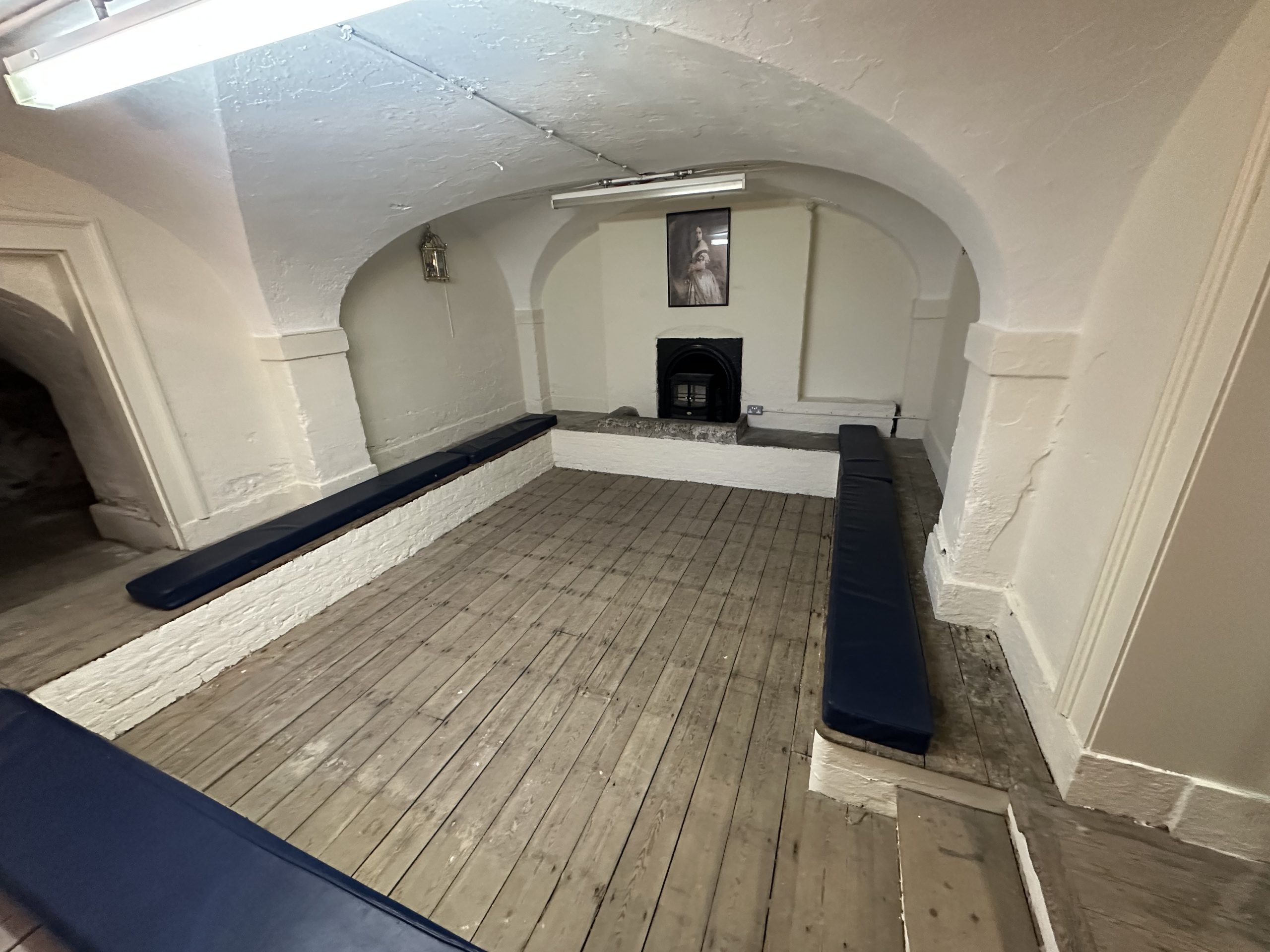
Except for one. In what is surely one of London’s best kept secrets, the remains of a second cockpit known as Cockpit (Whitehall) – still exists today preserved in Whitehall (above) in remarkable condition inside part of a working Army HQ.
It was built in the late 16th or early 17th century as a cockfighting area for the royal household and was in use for much of the time even when Henry Vlll’s original one, known as the octagonal cockpit, was in full use.
Cockpit (Whitehall) is reached after going up and down so many stairs it is easy to lose your bearings. There are two main rooms. The first (below) has what look like very old flagstones on the floor and seems to be used these days for office receptions and other entertainment.
 The ante-room to the cockpit
This leads to the actual cockpit space (top of article) which has clearly been altered because it is square whereas Tudor and later cockpits were all rounded. The floorboards look very old and I was told that if they were turned the other way up the stains from the blood of defeated cocks might still be visible.
The main structure of the room looks authentic but was probably changed to accommodate the needs of office and entertainment space after the taste for cockfighting had faded.
At first it might seem improbable that spectators would be sitting with their feet on the ground in the arena where cocks were trying to tear each other apart but if the Hogarth painting is correct (see the end of the article) this is what seems to have happened.
There are entrances nearby to part of a labyrinth of tunnels which still exist beneath Whitehall which could have been used to prepare the cocks for Cockpit (Whitehall)
One of the reasons why Cockpit (Whitehall) is virtually unknown is that Henry Vlll’s original one – known as the octagonal cockpit – dominated attention. It lasted until 1629 when it was turned into a handsome theatre for masques and plays for Charles l by Inigo Jones, Surveyor of the King’s Works. The octagonal cockpit was demolished around 1675 but remains of it are believed to exist beneath the floor levels of 70 Whitehall but are not accessible to the public.
After the restoration of the monarchy, following Cromwell’s interregnum when entertainments such as plays were banned, Charles ll built another royal cockpit at Birdcage Walk with steps, which still exist today called Cockpit Steps, to provide an entrance from Queen Anne’s Gate. Hogarth’s painting reveals some of the goings on during a cock fight. It shows a rowdy crowd of all social classes including in the middle a blind aristocrat Lord Albermarle whose winnings are being pocketed by drunken bystanders. Albermarle was apparently a fixture at Cockpit Steps betting on the sound of the birds and the roar of the crowd. Hogarth uses him as a metaphor for the degradation of the sport. As usual, there is a story behind practically every part of Hogarth’s painting.
Cock fighting was a national obsession and, curiously, a bit of a leveller as aristocrats would participate in often rowdy, alcohol-fuelled games with heavy gambling in the same space as commoners though not necessarily side-by-side. The cocks did not need any special training as they were constitutionally hostile and territorial towards each other. They were often made even more aggressive by being given special doses of alcohol.
 Hogarth’s painting at Cockpit Steps
Cockpit (Whitehall) is within a stone’s throw of another hidden gem, Cardinal Wolsey’s wine cellar, later acquired by Henry Vlll. It is on the other side of Whitehall buried within the Ministry of Defence building. Both the Cockpit and the wine cellar are Tudor but, sadly, not open to the public for the same reason. Security. I am very grateful to have secured permission to visit it.
 The steps to the Cockpit at Cockpit Steps still exist today with some of the original bricks probably still in place. When it was closed it was moved to Tufton Street at the other side of the Abbey. Cruikshank has done a memorable cartoon of it (above)
